

The Reserve Bank of India and NPCI have transformed UPI from a simple bank-to-bank transfer system into a comprehensive payment network. Today, the choice between UPI Lite vs RuPay credit card or a pre-sanctioned credit line dictates whether you are spending your own money or borrowing from a bank.
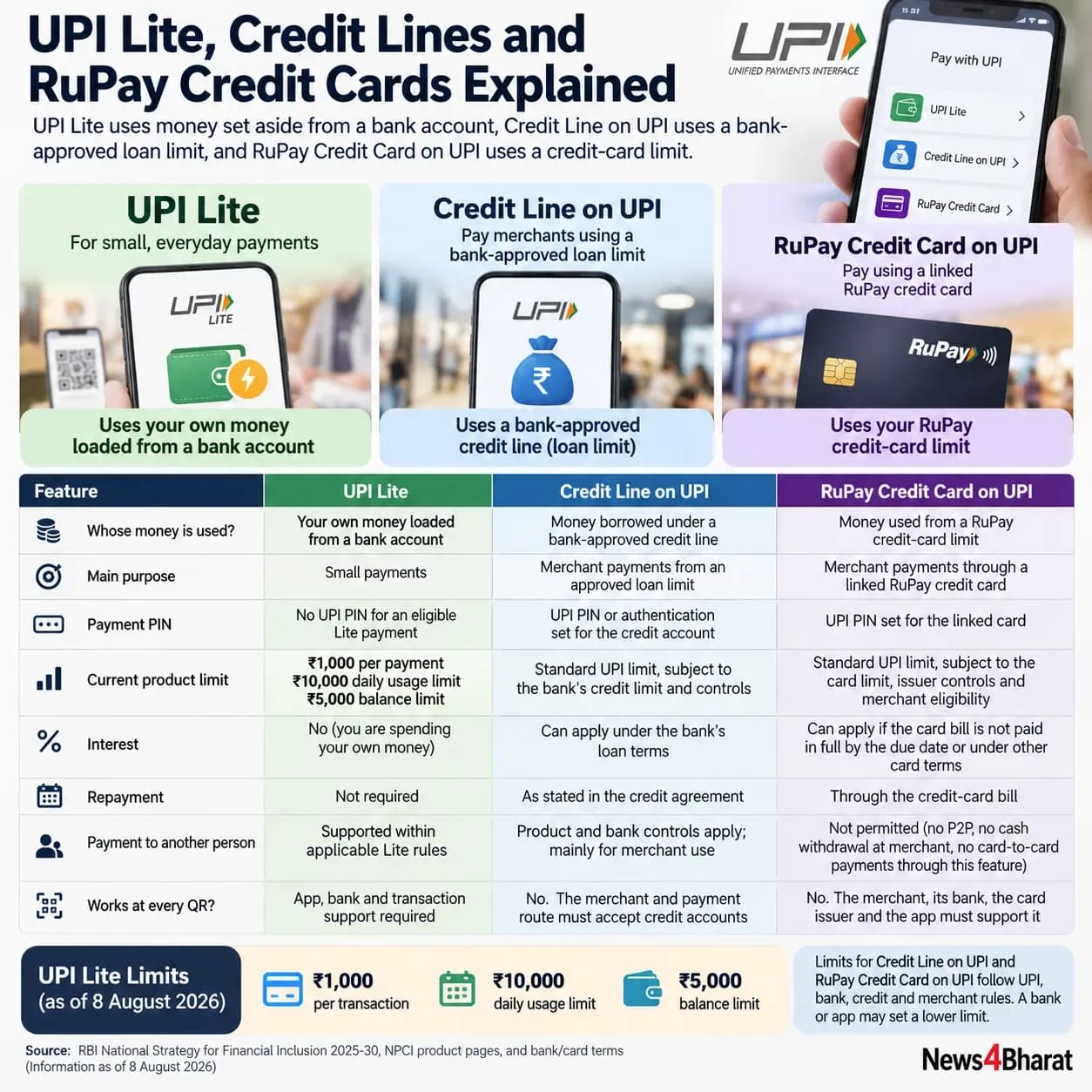
The three options can appear inside the same UPI app, but they do not draw money from the same place. UPI Lite is for payments from a balance funded by the user. Credit Line on UPI is a loan facility sanctioned by a bank. Making a UPI payment using credit card limits lets an eligible cardholder pay a merchant by scanning a UPI QR or using a UPI payment route.
The difference decides whether a payment needs a UPI PIN, whether interest can apply, where the transaction appears, which merchant can accept it and what happens after the payment. A ₹300 payment from UPI Lite reduces the user's Lite balance. The same ₹300 paid from a credit line creates a loan use. Paid through a RuPay credit card, it becomes part of the card account and its billing cycle.
As of 12 October 2026, the UPI Lite limit is capped at ₹1,000 per transaction, with a ₹10,000 daily usage limit and a ₹5,000 balance limit. Credit Line on UPI and RuPay credit card UPI limit rules follow standard UPI, bank, credit, and merchant guidelines. This comprehensive guide explains the three products, their costs, limits, setup, merchant use, safety rules, data and regulation history.
Key facts: UPI Lite vs Credit Line on UPI vs RuPay Credit Card
| Question | UPI Lite | Credit Line on UPI | RuPay Credit Card on UPI |
|---|---|---|---|
| Whose money is used? | The user's own money, pre-loaded from a linked bank account. | Money borrowed under a bank-approved pre-sanctioned credit line. | Money used from an active RuPay credit-card limit. |
| Main purpose | Small, rapid payments (P2P and P2M). | Merchant payments (P2M) from an approved loan limit. | Merchant payments (P2M) through a linked RuPay credit card. |
| Payment PIN | No UPI PIN required for eligible Lite payments. | UPI PIN or the specific authentication set for the credit account. | UPI PIN set specifically for the linked credit card. |
| Current product limit | ₹1,000 per payment, ₹10,000 daily use, ₹5,000 balance. | Standard UPI limit, subject to the bank's strict credit limit controls. | Standard UPI limit, subject to the card limit and merchant eligibility. |
| Interest risk | No, because the user is spending fully funded money. | Yes, can apply immediately under the bank's loan terms. | Yes, if the total card bill is not paid in full by the due date. |
| Repayment | Not required. | As stated in the credit agreement (EMIs or lump sum). | Through the standard monthly credit-card bill. |
| Payment to another person (P2P) | Supported seamlessly within applicable Lite rules. | Prohibited. Product and bank controls restrict this to merchant use. | Prohibited. Person-to-person, cash withdrawal, and card-to-card payments are blocked. |
| Works at every QR? | Yes, if app, bank, and transaction parameters are supported. | No. The merchant and payment route must accept credit accounts. | No. The merchant, its bank, the card issuer and the app must support credit acceptance. |
The limits above come from the RBI National Strategy for Financial Inclusion 2025-30, NPCI product pages and the user's bank or card terms. Note that while the NPCI sets these maximum network limits, individual participating banks or UPI apps may impose lower limits for risk management.
Will UPI payments become chargeable? The latest Bill status
UPI Recent Updates in 2026
UPI moved beyond payments funded only by savings and current accounts. UPI Lite added a funded balance for small payments in 2022. RBI allowed a RuPay credit-card account to be linked to UPI in the same year. In September 2023, RBI allowed banks to offer a pre-approved credit line as another UPI payment source. The offline variant, bounded by the UPI Lite X limit (₹500 per transaction, ₹2,000 balance), also arrived to support offline payments.
The result is a payment screen that can show the user's own money beside two forms of borrowing. The scan and approval steps can look similar, but the cost, repayment and acceptance rules are drastically different.
UPI is the payment route, not always the source of money
UPI began as a way to move money between bank accounts. A user selected a savings or current account, scanned a QR, entered a UPI PIN and the bank account was debited. The system now allows more types of accounts or balances to appear behind the same payment action. A UPI app may show:
- A standard savings or current account
- A UPI Lite balance
- A pre-sanctioned credit line
- A linked RuPay credit card
- A full-KYC prepaid wallet, where supported
The QR code merely starts the payment. The account selected before approval decides the source of funds and the financial rules that apply. This is why the words "paid through UPI" no longer prove that money came from a bank deposit. They describe the route. The funding source may be the user's balance or borrowed money.
What is UPI Lite?
UPI Lite is an on-device payment balance designed exclusively for high-volume, small-value transactions. The user enables it in a supporting UPI app and adds money from a linked bank account. An eligible payment is then deducted from the Lite balance without asking for a UPI PIN each time.
The Reserve Bank's May 2026 financial inclusion strategy describes UPI Lite as a system that processes small payments without checking the payer's core bank system in real time. The document says this reduces the load on the banking infrastructure and significantly improves payment success rates in low-connectivity areas.
UPI Lite is not a loan. It does not create a card bill. Loading ₹2,000 into Lite moves the user's money into the Lite balance available for payments. Spending ₹250 leaves ₹1,750, subject to any later top-up or refund.
The hidden winners of India's UPI boom: Infrastructure, soundboxes, lending and fraud controls
Current UPI Lite and UPI Lite X Limits (October 2026)
| Limit Type | UPI Lite Amount | UPI Lite X (Offline) Amount |
|---|---|---|
| Maximum per payment | ₹1,000 | ₹500 |
| Cumulative use in a day | ₹10,000 | ₹4,000 |
| Maximum balance at one time | ₹5,000 | ₹2,000 |
The Reserve Bank raised the per-payment and balance limits late in 2024 to accommodate inflation and user demand. The NPCI UPI Lite page confirms it as the primary PIN-free option for everyday micro-payments.
What is Credit Line on UPI?
Credit Line on UPI allows a customer to use a pre-sanctioned bank credit line as a payment source directly inside a UPI app. The bank first assesses the customer (usually based on deposit history or credit score) and approves a limit. After the facility is linked, an eligible payment can draw from that limit instead of the savings account.
RBI enabled pre-sanctioned bank credit lines through UPI in late 2023. The rule covers credit lines issued to individuals with prior explicit consent. The bank decides the sanction, limit, price, repayment method and use controls under its board-approved credit policy. By December 2024, RBI expanded this to Small Finance Banks.
A credit line is a loan, not an extra bank balance
Suppose a bank sanctions a ₹50,000 credit line and the user pays ₹4,000 to an eligible merchant. The available limit falls to ₹46,000. The amount used immediately becomes a credit exposure under the bank's terms.
Clarifying Credit Costs: The cost can differ sharply by product.
**Interest:** A bank may charge interest from the exact date of use (unlike credit cards, which usually have an interest-free grace period).
**Processing Charges:** There may be one-time activation fees or flat processing fees upon drawing down the line.
**Annual Fees:** The bank might charge a yearly maintenance fee for keeping the credit line active, regardless of usage.
**Repayment Obligations:** The lender may require bullet repayment at the end of the month, or auto-convert the spent amount into EMIs.
Before accepting the facility, the customer must check the Key Facts Statement (KFS), which details the Annual Percentage Rate (APR), interest start date, penal charges for missed payments, and whether part-payment restores the limit.
What is RuPay Credit Card on UPI?
RuPay Credit Card on UPI lets a customer link an eligible RuPay credit card to a UPI app and use the card account for merchant payments. The customer can scan a supported merchant QR, select the linked card and approve the payment with the card's specific UPI PIN. The physical card is not required at the counter. The UPI app provides the payment route, but the transaction remains a credit-card transaction for billing, limit use, refunds, and repayment.
What RuPay Credit Card on UPI does not allow (P2P Rules)
To prevent money rotation and cash withdrawal schemes, NPCI strictly enforces that this feature does not permit:
- Cash withdrawal at a merchant (cash-at-POS).
- Person-to-person (P2P) payments (e.g., sending money to a friend's phone number).
- Person-to-person payments attempting to masquerade as a merchant payment.
- Card-to-card payments or loan settlements.
It is meant purely for eligible P2M (Person-to-Merchant) purchases. Some merchant categories (like crypto, gambling, or stockbroking) can be blocked under network, issuer or regulatory controls.
Understanding RuPay UPI Card Interest and Charges
A RuPay credit-card payment made through UPI enters the exact same card account as a physical card swipe. It is included in the standard card statement and consumes the available credit limit.
The Interest-Free Period: If the total amount due is paid by the statement due date, the card's interest-free period (usually 20 to 50 days) applies normally. However, RBI's credit-card regulations dictate that when the total amount due is not cleared by the due date, this interest-free period is immediately revoked. In such cases, RuPay UPI card interest is charged retroactively from the actual transaction date on the outstanding amount, adjusting for partial payments.
RuPay UPI payment charges: From a consumer standpoint, scanning a QR and paying via a RuPay credit card does not incur an extra UPI convenience fee. However, merchants bear a Merchant Discount Rate (MDR) for credit transactions (often exempted for transactions below ₹2,000 to encourage small ticket adoption). If a merchant refuses a RuPay credit card payment, it is usually because their payment aggregator has disabled credit acceptance to avoid MDR costs.
Which UPI Payment Option Should You Choose?
To understand the practical difference, here is how the three mechanisms handle five everyday payment scenarios:
1. Buying tea or groceries with your own money (₹50 - ₹500)
Best Choice: UPI Lite. Since this is a low-value transaction using your own funded money, UPI Lite is the fastest option. It clears instantly without requiring a UPI PIN, avoids cluttering your main bank passbook with micro-transactions, and works seamlessly at any merchant QR code.
2. Purchasing a ₹25,000 appliance using a bank loan
Best Choice: Credit Line on UPI. If you do not have a credit card but have a pre-sanctioned credit line from your bank, you can scan the electronics store's QR code and select the Credit Line. This is a borrowing event. Ensure you understand if the bank will charge interest immediately or convert the ₹25,000 into monthly EMIs.
3. Paying a ₹5,000 restaurant bill to earn reward points
Best Choice: RuPay Credit Card on UPI. You scan the restaurant's QR, select your linked RuPay card, and enter your card's UPI PIN. You are borrowing money, but if you clear your credit card bill in full by the due date, you pay zero interest while earning the card's reward points. (Note: The restaurant's QR must have credit acceptance enabled).
4. Transferring ₹2,000 to a friend for a shared cab
Best Choice: Standard UPI Bank Account or UPI Lite. You cannot use Credit Line on UPI or a RuPay Credit Card to send money to individuals (P2P). These credit avenues are strictly blocked for P2P transfers to prevent cash rotation. You must use your own funds.
5. Paying at a small vendor whose QR rejects credit payments
Best Choice: Standard UPI Bank Account or UPI Lite. If a merchant uses a basic P2P QR code or has explicitly opted out of credit MDR charges, selecting RuPay Credit Card or Credit Line will result in a failed transaction prompt. You will be forced to switch the payment source back to your own savings account or UPI Lite balance.
Failed Transactions, Refunds, and Disputes
When a transaction fails or requires a refund, the rules depend heavily on the funding source:
- Auto-Reversals: For failed UPI merchant payments (where money leaves your account but doesn't reach the merchant), RBI's turnaround-time framework mandates auto-reversal within T+5 days. A penalty of ₹100 per day applies for delays beyond that period.
- Refund Routing: If you buy a shirt using a RuPay Credit Card on UPI and later return it, the merchant's refund will route back to your credit card account (restoring your credit limit). It will not go into your savings account. The same applies to Credit Line refunds.
- App Support vs. Bank Support: Your UPI app (like Google Pay, PhonePe, or BHIM) provides the frontend UI/UX. However, backend transaction processing, credit sanctioning, interest calculations, and final dispute resolutions are handled by your issuing bank. If a credit line charges unexpected interest, you must raise the dispute with the lending bank, not the UPI application.
NPCI's verified UPI name update: what users see before sending money
Data and Latest Developments (2026)
NPCI continues to record massive transaction volumes. In mid-2026, biometric-authentication-based UPI transactions (including RuPay Credit Card on UPI) crossed major milestones, indicating users are rapidly adopting alternatives to standard savings account payments.
Furthermore, NPCI's updated BHIM UPI QR guidance explicitly states that the "Pay with Credit on UPI" callout should only be displayed on sale-specific QRs where the merchant has actively accepted credit-account transactions, reducing checkout confusion.
Safety and Complaint Checklist
- Check the account name shown before approving the payment.
- Check whether the selected source is Lite, bank account, credit line or credit card.
- Enter a UPI PIN only on the app's UPI PIN page. A receiver does not need the payer's PIN.
- Do not share a card OTP, UPI PIN, app passcode or screen-control access.
- Review the Lite history, credit-line account and card statement separately.
- Report an unauthorised transaction to the bank or issuer without delay.
- Keep the complaint number, transaction reference, amount, date, merchant name and screenshots.
RBI's customer liability framework links protection in unauthorised electronic transactions to the source of the fault and how quickly the customer reports it. The first complaint should always go to the bank, card issuer or payment provider.
News4Bharat POV
UPI is evolving into an account-selection layer. The scan remains familiar, but the money behind the scan has a fundamentally different cost and legal character depending on what you select.
UPI Lite expertly moves small payments away from the bank's core system. Credit Line on UPI removes the need for a physical card to use an approved loan at a merchant. RuPay Credit Card on UPI extends card acceptance to millions of QR codes.
The benefit is immense access. The risk is that the frictionless payment screen can make borrowed money feel exactly like a bank balance. A user who pays by credit at ten small merchants may see only one action repeated: scan, select and approve. The financial obligation appears later in a loan account or card statement.
Official Sources: RBI National Strategy for Financial Inclusion 2025-30, RBI notifications on pre-sanctioned credit lines, RBI UPI Lite limit circulars (2024), NPCI product statistics, and BHIM UPI merchant guidelines.
Payments and Credit Disclaimer: UPI functionality, eligibility, limits and fees may vary by bank, card issuer, merchant and payment application. Credit Line on UPI and credit-card transactions may create repayment obligations and interest charges. Verify current terms with the issuing institution before using a credit facility.